They say a rolling stone gathers no moss.
In the world of Sharmistha Roy Chowdhury, art is never still. It’s never content resting only within the four corners of a canvas. Her ink knows no boundaries, her stories always refuse to sit tight. They are fluid at the core, finding ways from one surface to another, from one form to the next. Because for Sharmistha, art that doesn’t journey, doesn’t live. And what doesn’t live, she cannot call that art.
This trans-media movement isn’t a strategy. It’s a necessity. Just like water seeks its own level, her art seeks new vessels. The saree becomes a scroll. The mug, a morning mantra. The ceramic pendant becomes a quiet homage to a forgotten forest deity. The transition is deeply meditative — an act of faith in the fluidity of art and life.
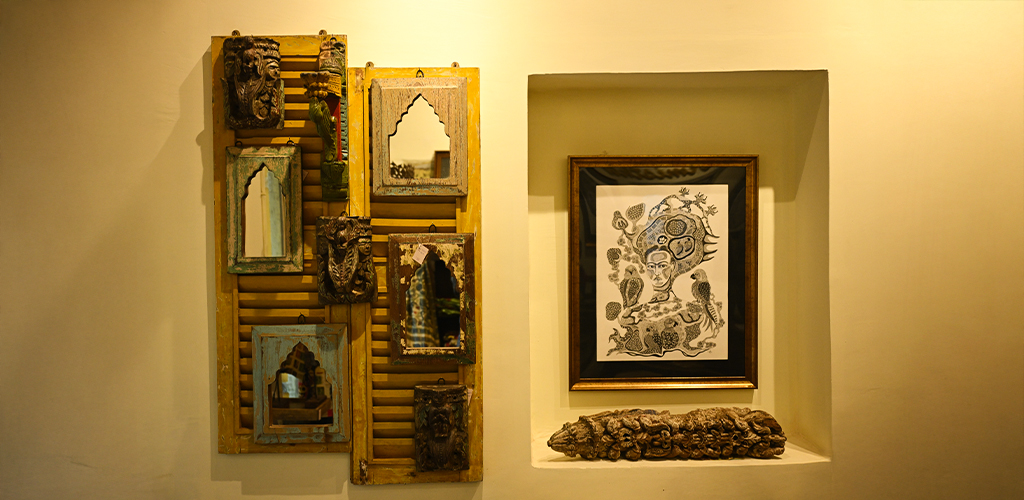
Her paintings do not ever get ‘transferred’ onto objects — they get reincarnated, let alone interpreted. Quite like the ten avatars of Lord Vishnu, each medium births a new avatar of the same story. Like one of her favourite muses—the folksy parrots—they mimic the same story in different accents: perching face to face on a saree, resting quietly along the edge of a mirror frame, or discovering the sky within a woman’s mind on a ceramic pendant. The pigment “Red Ochre” remains ancient, the spirit contemporary. Whether it’s linen, silk, ceramic, or wood, each carries the whisper of the original canvas, but speaks in a new tongue.
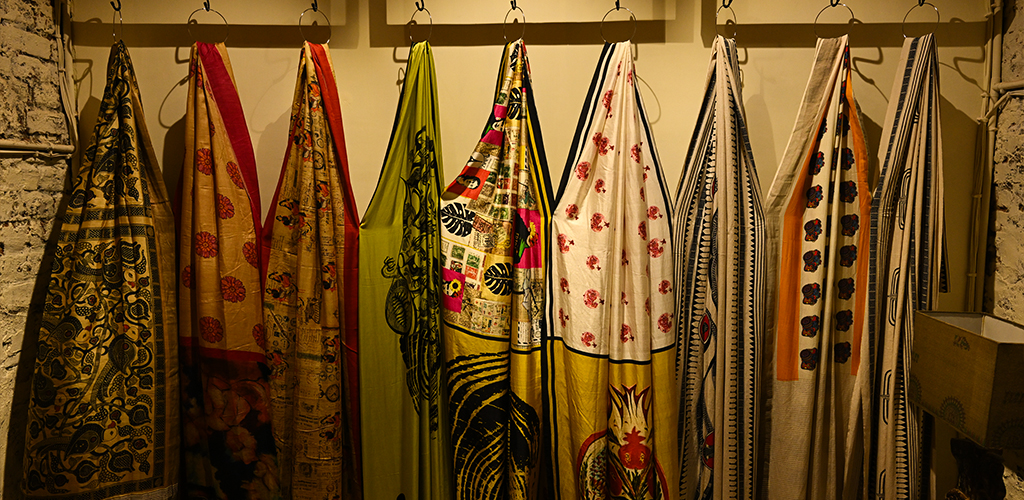
At the heart of this journey is the saree. Six yards of time travel, woven into today. Sharmistha’s sarees do more than merely draping the body — they awaken it. Folk idioms, tribal motifs, earthy hues, and symbols, stanzas from timeless literature — all converge in a choreography of thoughts. And this movement doesn’t stop at fabric. Clay, with its baked memory of earth, becomes another faithful companion. Her ceramics — pendants, mugs, platters, artefacts — carry fragments of murals, echoes of madhubani and patachitra, dots and lines that have danced across tribal homes for centuries. The tactility of clay lets her re-imagine ancient storytelling into everyday rituals — sipping chai, setting a table, gifting warmth.
Then comes wood as a surface. Burnished, carved, etched, and salvaged, wood bears the bruises and blessings of time. And it, too, like a wise old storyteller, welcomes the pigment. The journey of the art onto wood is often the quietest, but never the least powerful. It’s an act of engraving memory itself.
Sharmistha’s art doesn’t believe in a hierarchy of mediums. A scrap of locally sourced textile can hold as much possibility as an expensive, world-class canvas. An upcycled tin, wooden print blocks— they all become pilgrims in her sacred procession of storytelling. For her, it is the story that must travel. The medium must simply keep up.
Her art doesn’t chase classical permanence. It plays with change. It doesn’t seek only perfection. It honors the process. And this is why her pen moves — instinctively, inevitably. From wall to weave, from vision to vessel.
In a world obsessed with signatures, Sharmistha Roy Chowdhury’s work carries many. Not just hers, but those of rivers, of forests, of grandmothers and forgotten gods. And these signatures must move. They must be worn, poured into, passed on. Otherwise, they’re just museum labels — static, silent, sacred only to the past.
Art that stands still becomes a relic. But art that moves becomes life.